
Sourdough Bread
A crackling golden crust, a soft open crumb, and that gentle tang. One loaf, five ingredients, and a starter that does the work while you wait.
The whole recipe in 60 seconds
Sourdough Bread, in 5 ideas
- The float test tells the truth. A starter that floats is full of gas and ready. A starter that sinks needs one more feed and a few more hours.
- Time is the second ingredient. A cold overnight proof gives better flavor, a taller loaf, and dough that scores cleanly instead of dragging.
- The Dutch oven is the steam room. The lid traps the loaf's own moisture for the first 20 minutes, which is what builds the thin, crackling crust.
- Score with confidence. One decisive slash, about 1/2 inch deep, held at a slight angle. A timid score seals shut and the loaf bursts at the side instead.
- Judge doneness by color. Pale sourdough is underbaked sourdough. Bake to a deep mahogany; the sugars in the crust are the flavor.
What you need
Ingredients
- 1 cup active sourdough starter (about 225 g), fed 8 to 12 hours before and doubled
- 1 1/2 cups warm water (about 350 g), around 85F
- 4 cups bread flour (about 500 g), plus more for dusting
- 2 tsp fine sea salt (about 10 g)
- Rice flour or extra bread flour, for the proofing basket
How to make it
Method
 Feed your starter 8 to 12 hours before mixing: it should be doubled, bubbly, and smell sweet and tangy. Drop a spoonful in water; if it floats, it is ready.
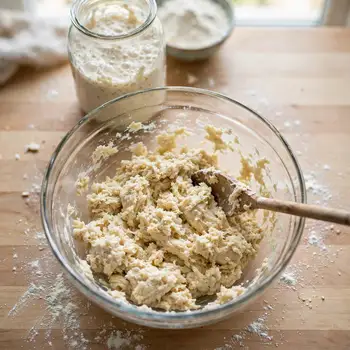 Whisk the starter and warm water together in a large bowl. Add the flour and mix to a shaggy dough with no dry patches. Cover and rest 30 minutes, then sprinkle the salt over the top and pinch and fold it in until the dough feels smooth.
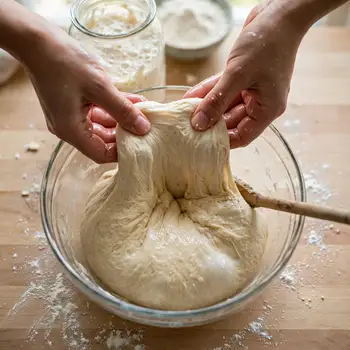 Bulk ferment at room temperature for 4 to 5 hours. Every 30 minutes for the first 2 hours, wet your hand and do a set of stretch and folds: pull one side of the dough up and over the center, turn the bowl, and repeat 4 times. The dough is ready when it has risen about 50 percent, feels airy, and jiggles when you shake the bowl.
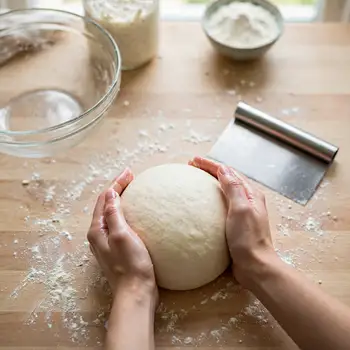 Tip the dough onto a lightly floured counter. Fold the edges into the center, flip it seam side down, and drag it toward you in small circles to build a tight, smooth surface. Rest 20 minutes, then shape it again the same way.
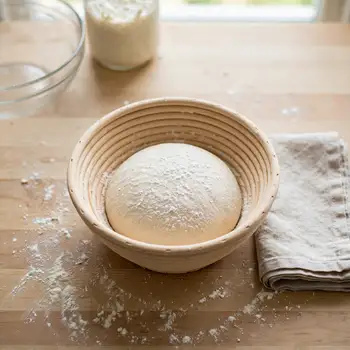 Set the loaf seam side up in a floured proofing basket or a bowl lined with a floured towel. Cover and refrigerate 8 to 12 hours, overnight is perfect. Cold proofing is where the flavor and the easy scoring come from.
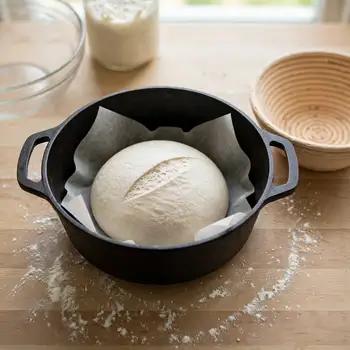 Heat the oven to 500F with a Dutch oven inside for 45 minutes. Turn the cold loaf onto parchment, score one deep slash about 1/2 inch deep at a slight angle, lower it into the hot pot, cover, and bake 20 minutes. Uncover, drop the heat to 450F, and bake 20 to 25 minutes more until deep mahogany.
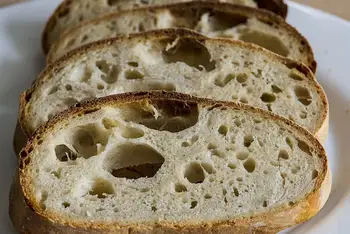 Cool on a rack for at least 2 hours before slicing. The crumb is still setting, and cutting early makes it gummy. Slice thick, and listen: the crust should crackle as it cools.
No starter yet? Stir equal parts flour and water (50 g each) in a jar, feed it the same way every day, and in 7 to 10 days it will double reliably and be ready to bake with. Keep it in the fridge between bakes and feed it the night before you mix.